Technology
From the sensor to adaptive grasping.
The Hyper Tact project brings together tactile-sensor research, computing hardware and artificial intelligence. The goal is a system that detects contact on the gripping surfaces and uses that feedback to regulate handling.
- Already tested
Tactile sensor
The sensing technology at the core of the project has been put through testing. That work is the starting point for developing the Hyper Tact gripper.
- Next phase
Integration into the gripper
We are developing the path for integrating the sensor into the robotic gripper. The design foresees distributed sensitive surfaces and an architecture that links detection to grip control.
- Planned development
Artificial intelligence
The AI component will be developed to interpret tactile data and contribute to perceiving the object's characteristics. Its functions will be defined and verified through development and testing of the system.
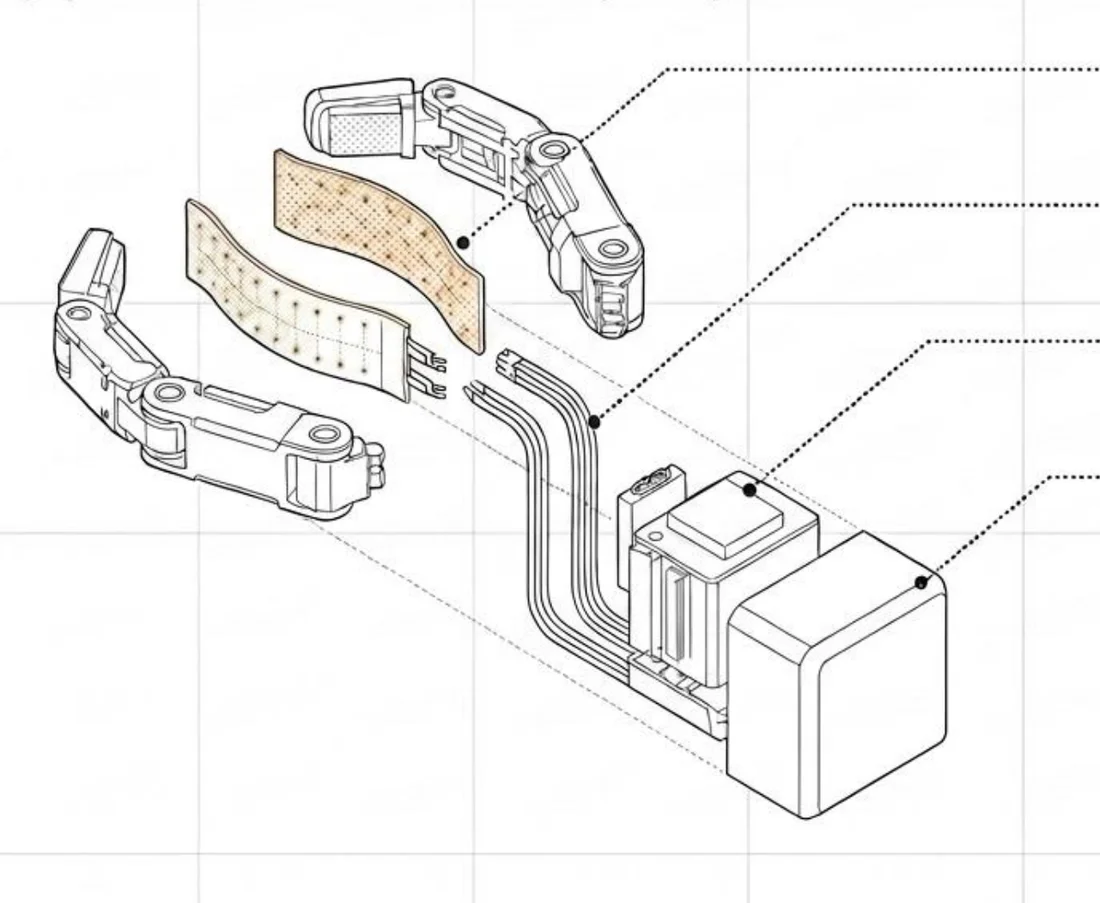
- Distributed sensitive surfaces. Tactile layers across the inner gripping surfaces, not a single contact point.
- Contact feedback. Contact information is made available to the grip controller.
- Adaptive control. The grasp is adjusted from the feedback to reduce damage to the object.
- Integrated architecture. Sensing and control electronics gathered in the gripper base.
Planned path
The milestones planned from concept to validation with industrial partners.
EIC Transition proposal
Submission, use-case selection, letters of intent and detailed work plan.
Project start
Collect partner requirements, refine specifications and priorities.
Prototype
Target TRL 6: gripper with integrated sensing ready for testing.
Integrator validation
Lab testing with system integrators, verification of industrial KPIs.
Scale and market
Production and commercialization preparation.
Milestones are planning targets and may change with the selected use cases and test results.